
As the term suggests, Ventricle Disproportion means a noticeable discrepancy between the sizes of the ventricles. The routine cardiac screening mandates the display of a 4-chamber view and involves identifying the ventricles and atria. In a normal fetus, the ratio of Right Ventricle (RV) and Left Ventricle (LV) is near one throughout, in most cases.
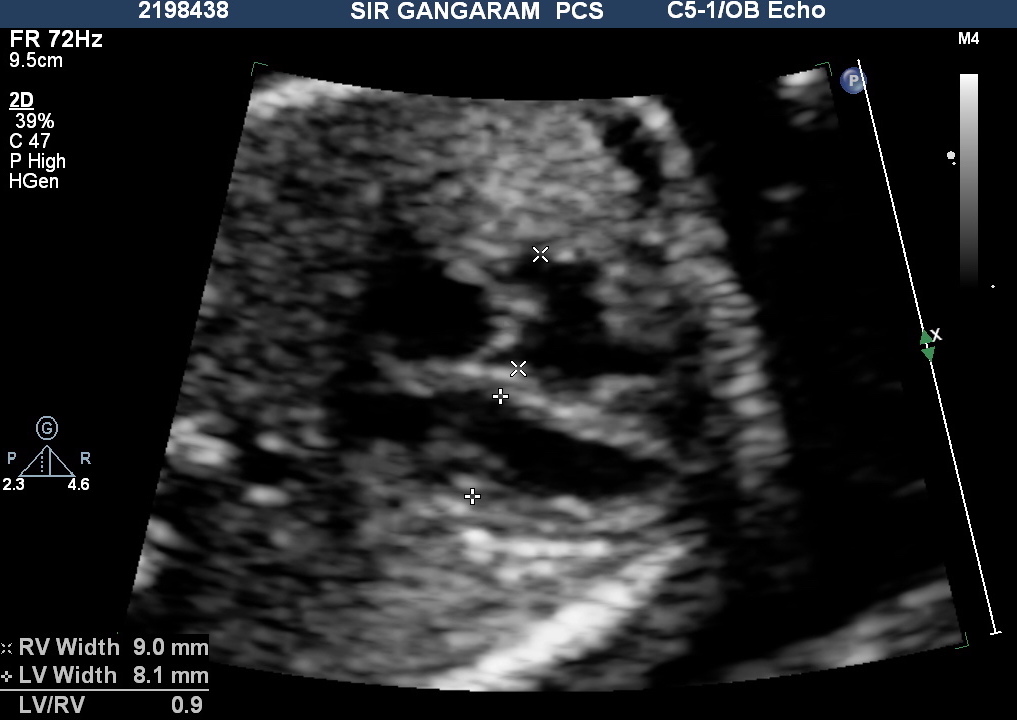
In practice, disproportion was noticeable without measurement when there was a 20 % difference in ventricular widths. A ventricular disproportion is a more specific marker in the second trimester, before 25-28 weeks of gestational age, and less in the third trimester. In the third trimester, there can be a degree of physiological disproportion. Thus false positive rate reaches very high, especially after 34 weeks when it is up to 80%. (Stos et al., 2007).
A study of RV and LV sizes and ratios by Rinat Gabbay-Benziv et al (2015) shows that the range of RV to LV ratio increases over time. But it is essential to notice that the mean remains around 1.
- 16 to 28 weeks Mean of 1.03 (range 0.86-1.23)
- 28-33 weeks mean of 1.033(range 0.85-1.26)
- 34-38 weeks mean 1.06 ( range 0.855-1.3)
As per classical teachings an RV to LV ratio of greater than 1.15 (LV to RV of <0.87 or 0.9) is considered abnormal and this holds value as a screening tool for RV enlargement. With these parameters, the positive predictive value is only 33% (Brown et al.). This is still valuable for screening of RV enlargement because it is easy to do, very reproducible and has less inter-observer variability.
The recommendation based on parameter studies and predictive value would be-
- It is a good practice to measure LV and RV width in all fetuses during cardiac screening.
- Any discrepancy between the right and left ventricle size should be noticed.
- The Z scores of the ventricle should also be determined in case of ventricle disproportion, and if the RV z score is more than +2 then RV should be considered dilated.
- If the ratio is more than 1.2 in the second trimester and more than 1.3 in the third trimester then Ventricle disproportion should be considered significant.
- In either case, the causes of dilated RV should be assessed along with other markers of coarctation suspicion.
- Ideally, all cases of Ventricular disproportion should have Fetal echo evaluation.
A study (Nisselrooij et al.) has investigated the postnatal outcome of Ventricular disproportion besides the development of Coarctation of the Aorta. The study shows that prenatal diagnosis of Ventricular disproportion is associated with a higher incidence of undiagnosed CHDs, Primary pulmonary hypertension and Syndromic features. Overall, 43% of all non-CoA children with ventricle disproportion, required some level of extended attention.
Causes of Right Ventricle Dilation in Fetal Echo
- Abnormal Pulmonary Venous drainage: TAPVC, PAPVC
- Absent Ductus Venosus
- Systemic AV malformation: Vein of Galen Malformation, Teratoma etc
- Abnormalities of Foramen Ovale: Restricted Foramen ovale
- Tricuspid Valve Abnormalities
- Tricuspid Regurgitation: Ebstein Anomaly, Other Structural Anomalies of the tricuspid valve
- Tricuspid Stenosis
- RV abnormalities: Uhl’s anomaly
- Pulmonary Valve Anomaly: Pulmonary Stenosis/ Pulmonary Regurgitation
- Left Sided Lesion:
- Mitral stenosis/ Atresia
- Aortic Stenosis/ Atresia
- Hypoplastic Arch
- Interrupted Arch
- Coarctation of Aorta
- Ductus arteriosus Anomaly
- Premature Restriction or Closure of Ductus Arteriosus
- Absent Ductus Arteriosus
- Pericardial Anomalies: Absent Pericardium
- Arrhythmia and Conduction defects
- Thoracic causes: Congenital Diaphragmatic Hernia, Congenital Cystic Adenoid Malformation, Other Thoracic masses
- Systemic Issues: Anaemia, Hypoxia
- Case report: Compression of the fetal neck by the umbilical cord(Więckowska et al.)
 Fetal Cardiac Care